Beyond the Numbers: How CFOs Make High-Stakes Business Decisions
A CFO is not simply responsible for reporting what happened. The real value of a CFO is often created before a major business decision is made.
Should we expand? Should we hire? Should we acquire a company? Should we increase prices? Should we take on debt? Should we invest more capital? Should we exit an underperforming market? Should we continue supporting a loss-making business unit?
These decisions rarely have a perfect answer. They involve incomplete information, competing priorities, financial constraints, operational risks, and uncertainty about the future.
This is where CFO-level decision-making becomes critical.
A strong CFO does not simply ask: "What do the numbers say?" The better question is: "What decision does the business need to make, what are the available alternatives, and what are the financial and strategic consequences of each?"
1. When revenue is growing but cash is falling
Consider a company where revenue increased by 30%, EBITDA increased by 15%, but cash decreased by 25%.
A basic financial review may celebrate the growth. A CFO investigates the contradiction: where is the cash going?
The CFO will examine accounts receivable, inventory, accounts payable, customer payment terms, supplier payment terms, working capital requirements, capital expenditure, debt repayments, and tax and other cash obligations.
Perhaps revenue growth has created a significant increase in receivables. The business is profitable on paper but is struggling to convert profit into cash.
The decision could involve tightening credit terms, improving collections, requesting customer deposits, renegotiating supplier terms, reducing slow-moving inventory, or adjusting the pace of expansion.
The CFO is not simply reporting a cash problem. The CFO identifies the economic driver and connects it to an actionable decision.
2. When management wants to enter a new market
Management may see a large market opportunity and propose expansion. The CFO's role is not simply to approve or reject the idea, but to convert the strategy into an economic model.
The analysis may include initial investment, market-entry costs, revenue assumptions, gross margins, employee costs, marketing, working capital, capex, tax, financing requirements, and expected cash flows.
Then the CFO tests different scenarios. Base case: revenue SAR 5M, EBITDA margin 15%. Downside case: revenue SAR 3.5M, EBITDA margin 8%. Upside case: revenue SAR 6M, EBITDA margin 18%.
The objective is not to pretend that one scenario will definitely happen. It is to understand how much capital is at risk, what assumptions drive the economics, how quickly the investment can recover, and what happens if the assumptions are wrong.
3. When revenue is growing but margins are declining
Suppose revenue is up 25%, gross profit is up only 8%, and gross margin has fallen from 35% to 30%.
Revenue growth alone does not explain whether the business is becoming stronger. The CFO investigates the drivers.
Is the company discounting more? Selling more low-margin products? Facing supplier cost increases? Losing pricing power? Serving less-profitable customers? Carrying higher logistics costs? Changing its product mix?
The CFO may perform product profitability analysis, customer profitability analysis, price-volume-mix analysis, and contribution margin analysis.
The decision might involve changing pricing, product mix, supplier contracts, customer terms, or cost structures. The important point is that the CFO does not stop at identifying that margin 4: When management wants to reduce pricesit.
4. When management wants to reduce prices
Pricing is often considered a sales decision. It is also a major financial decision.
Imagine a selling price of SAR 100, a variable cost of SAR 70, and therefore a contribution of SAR 30. Management proposes reducing the price to SAR 90, so contribution becomes SAR 20.
The CFO immediately asks: how much additional volume is required to compensate for the lower contribution per unit?
But the analysis should not stop there. The CFO should examine price elasticity, competitor pricing, customer segments, capacity constraints, contribution margin, customer lifetime value, market-share objectives, cash impact, and long-term pricing position.
The decision is not simply "Can we afford to reduce the price?" It is "Under what conditions 5: When management wants to hire more employees
5. When management wants to hire more employees
Hiring decisions can easily become emotional. A department may say: "We need 20 additional employees." The CFO converts that request into measurable economics.
For each hiring proposal: salary, benefits, recruitment costs, equipment, training, office costs, expected productivity, ramp-up period, and revenue contribution.
For revenue-generating positions, the CFO may evaluate cost per employee, then revenue contribution, then gross margin, then break-even period. For support functions, the analysis may focus on capacity, productivity, cost avoidance, control improvement, and risk reduction.
The CFO is therefore asking: what business problem are we solving with this headcount, and 6: When the company has excess cash
6. When the company has excess cash
Having cash on the balance sheet creates another decision: what should the company do with it?
Possible alternatives include investing in growth, repaying debt, acquiring another business, investing in technology, increasing working capital reserves, or returning capital.
Each alternative carries a different return, risk, liquidity impact, strategic impact, and time horizon. The CFO should compare the opportunity cost of each option.
The question becomes: "Where can the next SAR 1 million of capital generate the greatest strategic and economic value within the company's risk capacity?"
That is capital allocation, and it is one of the most important responsibilities of a CFO.
7. When management wants to take on debt
Debt can accelerate growth. It can also increase financial risk.
Before recommending additional borrowing, the CFO should examine existing leverage, debt service capacity, interest coverage, cash-flow stability, debt maturities, interest-rate exposure, currency exposure, financial covenants, and downside scenarios.
Then stress-test the business. What happens if EBITDA falls 20%? What happens if customers take another 30 days to pay? What happens if interest costs increase? What happens if revenue declines for two consecutive quarters?
The CFO should understand the company's ability to survive the downside before committing to the debt.
8. When one customer represents a large share of revenue
A customer generating significant revenue can appear attractive, but concentration creates exposure. Suppose one customer represents 35% of total revenue.
The CFO should examine revenue concentration, customer profitability, payment history, contract duration, renewal structure, credit exposure, dedicated resources, switching risk, and alternative customer opportunities.
The question is not simply "How profitable is this customer?" It is "How much of the company's economic performance depends on this relationship?"
Management may then consider diversifying the customer base, revising contract terms, requiring deposits, improving credit protection, reducing dedicated fixed costs, or developing alternative revenue channels.
A traditional P&L may not make this risk obvious. CFO analysis should.
9. When a business unit is losing money
A common management reaction is: "This business unit is losing money. Close it." But the CFO should first understand the economics.
The loss could be caused by low revenue, low gross margin, excess fixed costs, temporary market conditions, poor pricing, underutilised capacity, heavy corporate allocations, or initial investment.
The CFO separates accounting loss from contribution economics and from future economic potential.
A division reporting an accounting loss may still contribute positive cash contribution once avoidable costs are considered. Conversely, a division showing accounting profit may consume substantial capital while generating inadequate returns.
The decision therefore requires more than looking at the bottom line.
10. When considering an acquisition
An acquisition is one of the most complex decisions a CFO can support. The CFO needs to understand not only the target's reported earnings but also the quality of those earnings.
On financial performance: revenue, gross profit, EBITDA, operating cash flow, working capital.
On quality of earnings: recurring revenue, one-off income, unusual expenses, revenue concentration, customer retention.
On the balance sheet: debt, receivables, inventory, payables, provisions, contingent liabilities.
On commercial position: customers, contracts, pricing, market position, retention.
On synergies: cost synergies, revenue synergies, procurement opportunities, technology synergies.
Then comes one of the most important questions: what happens if the expected synergies do not materialise? The CFO should model delayed synergies, lower revenue, margin pressure, integration costs, and additional working-capital requirements.
The purchase price is only one part of the decision. The real question is whether the economics justify the capital, risk, and execution requirements.
11. When the forecast suddenly changes
Suppose the original expectation was revenue SAR 50M, EBITDA SAR 8M, and cash flow SAR 5M. Six months later the expectation is revenue SAR 45M, EBITDA SAR 6M, and cash flow SAR 2M.
Updating the numbers is not enough. The CFO needs to understand what changed: volume, price, mix, customer behaviour, costs, collections, headcount, capex, working capital?
Then comes the more important question: what can still be changed?
Some assumptions are no longer controllable. Others still are, and that distinction matters. A CFO should separate what happened from what is likely to happen from what management can still influence.
That is where financial analysis becomes decision support.
12. When the business faces a downturn
During difficult periods, the easiest recommendation is often: "Cut costs." But CFO-level decision-making requires more precision, because not every cost has the same economic value.
The CFO should distinguish between costs that create future capacity and costs that can be reduced without damaging the business.
Reducing sales capacity may improve short-term expenses but weaken future revenue. Cutting critical technology investment may create operational risk. Reducing inventory may release cash but increase stock-out risk. Delaying strategic investment may preserve liquidity but affect long-term competitiveness.
The CFO must therefore evaluate immediate cash preservation against future economic consequences.
13. When management has multiple investment opportunities
Imagine the company has SAR 10M available for investment and there are five possible projects.
Each project has different investment requirements, expected returns, risk, payback period, strategic importance, cash-flow profile, and execution complexity.
The CFO should not simply choose the project with the highest projected return. The analysis should consider the quality and risk of the assumptions, capital constraints, strategic dependencies, liquidity requirements, and downside exposure.
This is where portfolio thinking becomes important. The CFO is not only asking "What can generate the highest return?" but "How should we allocate limited capital across competing opportunities while protecting the company's financial resilience?"
14. How a CFO builds the decision before presenting it
Before bringing a major decision to the CEO or Board, the CFO should be able to answer six questions clearly.
First, what exactly are we deciding? Avoid vague proposals; define the decision.
Second, what are we trying to achieve? Growth, cash generation, margin improvement, risk reduction, market expansion, or strategic positioning?
Third, what are the alternatives? There is rarely only one option.
Fourth, what are the economics? Revenue, costs, cash flow, capital requirement, return, payback.
Fifth, what could go wrong? Identify the assumptions and risks that could materially change the outcome.
Sixth, how will we monitor the decision? Define the KPIs that will tell management whether it is delivering the expected result.
That creates a complete decision framework.
15. The CFO should make uncertainty visible
One of the biggest mistakes in executive decision-making is presenting assumptions as facts.
A CFO should clearly distinguish between what is known, meaning historical financial data and verified information; what is assumed, meaning inputs based on management expectations; what is estimated, meaning values derived from analysis or external information; and what is uncertain, meaning variables where the range of outcomes is significant.
This makes the decision more transparent. Instead of saying "The project will generate SAR 4M EBITDA", a CFO should be able to explain: "The model generates SAR 4M under the base assumptions. The most sensitive drivers are volume, gross margin, and customer acquisition cost."
That is a much more useful conversation for management.
16. The CFO decision-making loop
High-quality CFO decision-making is not a one-time event. It is a continuous cycle: data, then analysis, then drivers, then scenarios, then alternatives, then decision, then execution, then measurement, then feedback.
The process does not end when the Board approves the investment. The CFO should return later and ask: did the assumptions hold? Did the expected economics materialise? Where did actual performance differ? What did we learn? What should change in future decisions?
This creates an organisation that learns from its capital allocation decisions.
The difference between finance reporting and CFO decision-making
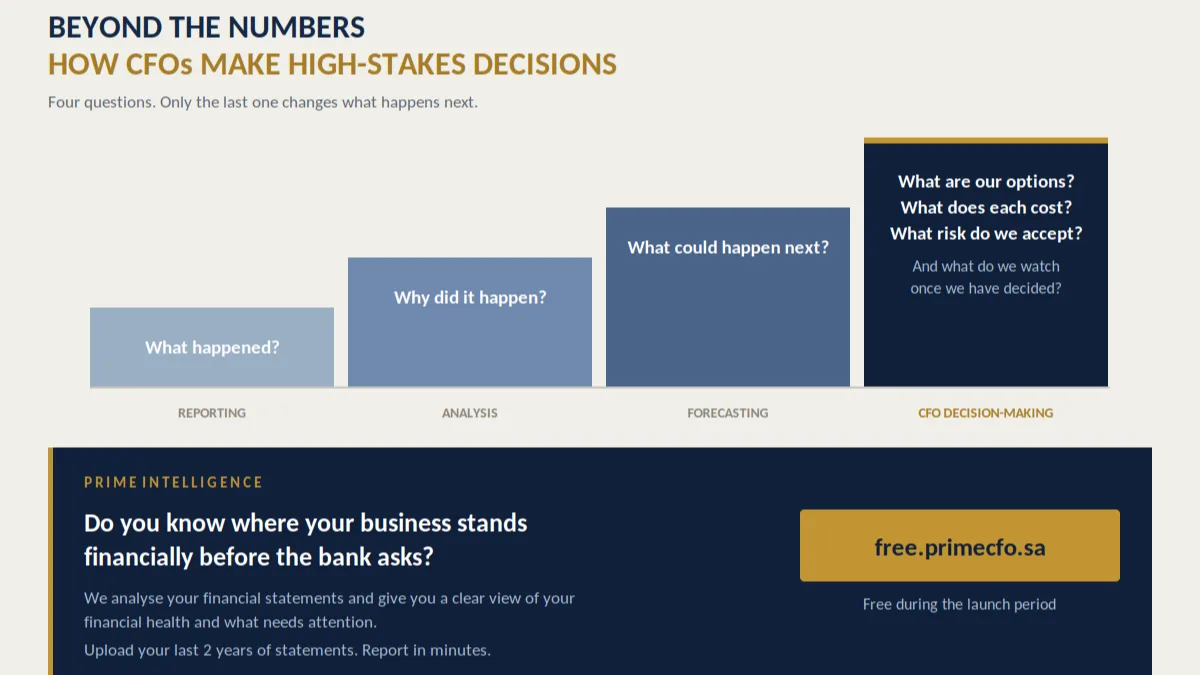
A reporting mindset asks: what happened? A strong analytical function asks: why did it happen? A forward-looking finance function asks: what could happen next?
CFO-level decision-making asks: what choices do we have, what are the consequences of each, what risks are we accepting, and what should we monitor after the decision?
That is a completely different role for finance. The CFO is not there simply to produce more reports. The CFO brings financial discipline to the company's most important choices.
Because every major business decision eventually affects revenue, margins, cash, capital, risk, returns, and ultimately enterprise value.
The strongest CFOs do not claim to know exactly what the future will look like. They build a decision process that allows management to act intelligently when the future is uncertain.
Numbers are the evidence. Analysis provides the context. Scenarios expose the uncertainty. Judgment connects everything to the decision. Execution determines the result.
That is where the CFO creates value.
Turning these ideas into a disciplined monthly practice is core to the work of a fractional CFO. To see where your company stands today, start with the instant financial diagnosis, free during our founding period.
Read next
Do you know where your company stands financially today?
Upload your last two years of financial statements and get a financial health score and sector comparison in minutes, free during our founding period. If you need executive financial leadership, we are here.
Try the free financial diagnosis