The Decision Nobody Makes: Capital Allocation in the Mid-Market
Ask a founder what their strategy is and you will get an articulate answer about markets, products and customers. Ask where last year’s cash went, in order of size, and the answer gets slower.
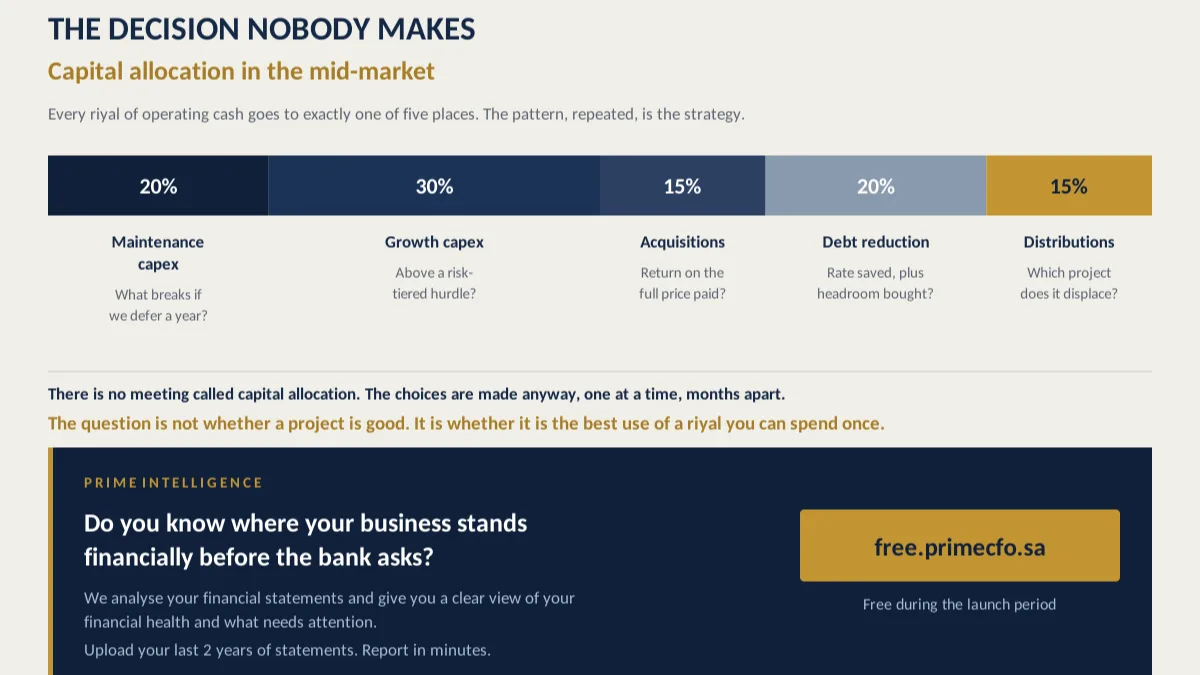
That second question is the strategy. Everything else is a description of it.
A company generates cash. That cash has a small number of possible destinations: maintaining what already exists, growing it, buying something, repaying debt, or returning money to shareholders. Every riyal goes to exactly one of them, and once it has gone there it cannot go anywhere else. The pattern of those choices, repeated over five years, is what the company actually becomes, regardless of what the strategy deck says.
In large listed companies this is a named discipline with a named owner and a board committee behind it. In companies between SAR 10M and 300M of revenue it is usually nobody’s job, and it happens anyway.
Why the decision is invisible
The reason capital allocation goes unmanaged in the mid-market is not negligence. It is that the decision never appears anywhere as a decision.
There is no meeting called capital allocation. There is a capex approval in March, a hiring plan in June, a loan repayment that leaves the account automatically on the fifteenth of every month, and a dividend discussed with the shareholders over two days in December. Each of these is sensible in isolation. Each has a different owner, a different forum and a different season. Nobody ever sees them laid side by side on one page, which means nobody ever compares them.
And comparison is the entire point. Capital allocation is not the question of whether a project is good. It is the question of whether it is the best available use of a riyal that can only be spent once. A project returning fourteen percent is a good project and a bad decision, if the alternative on the table was a project returning twenty-two.
Say that out loud in a management meeting and everybody agrees instantly. Then watch what happens over the following year, and the comparison still does not get made, because no process exists to force it and no single person feels the absence.
The result is four specific failures. I see at least two of them in almost every engagement, and all four more often than I would like.
The hurdle rate nobody has recalculated
Most companies have an investment hurdle rate. Very few can say when it was last built from first principles, and almost none can produce the working.
Twelve percent is the usual number and it is usually inherited. Someone calculated it properly once, several years ago, wrote it into the capital policy, and it has sat there ever since while the cost of debt, equity expectations and country risk all moved underneath it.
A hurdle rate is not a policy preference. It is a price. It is what the money you are about to spend actually costs, and like any price it changes. When the price rises and the gate does not, the company keeps approving projects that clear the gate and lose money anyway.
What makes this so durable is that nothing visibly breaks. The projects get approved. The returns come in roughly as forecast. No single decision looks wrong. The business simply grows its way into a lower return on capital, one defensible decision at a time, and three years later somebody notices that the company is much larger and no more valuable.
There is a second version of the same problem, which is applying one rate to everything. Replacing a machine that already has a known output and entering a market the company has never operated in are not the same risk and should not face the same bar. A single uniform hurdle means either the safe projects are being over-rewarded or the risky ones are being systematically under-priced. Usually both, in the same portfolio, at the same time.
Projects get approved, not ranked
Almost every capital process in a mid-market company is a pass or fail gate. A proposal arrives, it is assessed against the hurdle, it passes, it gets approved. Another proposal arrives in six weeks and goes through the same gate entirely independently.
This logic works only if capital is unlimited, which it is not. Sequential approval means the project that happened to be ready in March gets funded, and the better project that was ready in September does not, because by then the money is committed and the answer is next year.
Nobody designed it this way. It is simply what happens when there is no list.
The fix is unglamorous and it works. Maintain a standing list of every material use of capital available over the next eighteen months, ranked by expected return against the risk attached to it, and fund down the list. Refresh it quarterly. Keep it on one page.
The list will be wrong in its details. Forecasts five years out on a volatile business are not precision instruments, and the ranking between the third and fourth item is largely arbitrary. That is fine. The value is not in the ordering being exactly right. It is that the conversation changes from “is this a good project” to “is this better than the other things we could do with the same money,” and those two conversations produce different companies.
The list should also include the things nobody will ever submit as a project. Paying down the facility is a use of capital. Buying out a minority shareholder is a use of capital. Holding cash so that you can move quickly when something becomes available is a use of capital with a real and calculable return. None of these arrive in a template with a business case attached, so none of them get compared against the ones that do. They are often the best thing on the list.
The base is never questioned
Open the budget model and look at where the money actually sits. The overwhelming majority of next year’s spending is this year’s spending, carried forward with an inflation assumption applied to it. The genuinely new requests, meaning the extra heads, the new programme and the system, are a small slice of the total.
Now look at where the scrutiny goes. Almost all of it lands on that small slice. The base passes through untouched, because it passed through last year, and the year before that, and because the person who originally approved it has usually left.
So the heaviest challenge in the entire process is applied to the smallest number, and none at all to the largest.
This is how cost structures and asset bases drift. Not through bad decisions, but through decisions that were entirely correct four years ago and have never been revisited since. A tool nobody opens any more. A team built around a product that was discontinued. A maintenance contract renewed by default every January. A warehouse lease sized for a volume that peaked in 2023. Each one made sense when it was signed, and each one is still being funded on the strength of that original logic.
Nobody is defending these items, because nobody is attacking them.
There is no verdict
The capital process is beautifully constructed right up to the moment of approval, and then it stops dead. There is a committee, a template, a hurdle rate, a discounted cash flow, a sensitivity table. The money is spent. The project goes live. And the business case is never opened again.
This matters for a reason that has nothing at all to do with blame. Nobody learns anything.
If the last four system implementations delivered roughly half their promised benefit, that is not four people being dishonest. It is a pattern, and it should change how the fifth proposal is read. Without the look back, every new case arrives at the committee as though it were the first one anyone had ever written, and the same optimism is priced at face value every time.
It also changes behaviour at the front end, quietly and immediately. A forecast you know will be read back to you in eighteen months is a different document from one you know will not. That effect is worth more than the review itself.
The objection is always capacity, and it is overstated. This does not require an audit function. It requires one page, twelve months after go-live, written by the same person who wrote the original case and read by the same committee that approved it: what we said, what happened, what we would do differently. An hour of work. The discipline is in it being unavoidable, not in it being thorough.
What each use of capital actually has to answer
If the comparison is going to happen, each destination needs a question it must answer in the same currency as the others.
Maintenance capex is the one most often waved through, because it is presented as non-discretionary and nobody wants to be the person who refused to replace the compressor. But most of it is discretionary over some horizon, and the question is simply what breaks, and when, if this is deferred twelve months. Sometimes the honest answer is nothing, in which case it is not maintenance. Sometimes the answer is that the line stops in March, in which case it is the highest-returning thing on the list and should be funded first without further debate.
Growth capex is the category the process was designed for, so it usually gets the most rigorous treatment and still fails on two points: the hurdle it is tested against is stale, and that hurdle is the same one applied to far safer spending. Growth capex should face a risk-tiered rate and arrive with a named owner who will still be there when the post-implementation review lands.
Acquisitions are almost always assessed against synergies rather than against capital. The deck shows what the combined business looks like and what cost can be taken out. It rarely shows the return on the full amount paid, including the integration cost and the management attention consumed, measured against the same hurdle every other project has to clear. Run that calculation and a meaningful number of deals do not survive it.
Debt reduction is the destination that never appears on anyone’s project list, because it is not a project. It is also, in a rising rate environment or anywhere near a covenant, frequently the best available return. The rate saved is certain, and the headroom bought has a value of its own that nothing else on the list provides. A facility paid down is optionality purchased, and optionality is worth the most precisely when it is cheapest to buy.
Distributions to shareholders are usually treated as a residual: what is left after everything else. That is backwards. A dividend is a decision that the owners can do better with the money than the company can, and it should be defended on exactly that basis. The honest framing is to name the project it displaces. Sometimes the answer is that nothing on the list clears the bar, and in that case distributing the cash is unambiguously the right call and should be said with confidence rather than apologised for.
The argument against all of this
It deserves stating properly, because it is not a weak argument.
Process has a cost. A ranked list, tiered hurdle rates and annual post-implementation reviews consume finance capacity that mid-market companies do not have sitting spare, and they introduce delay into decisions where speed is itself worth something. A founder-led business that can move on an opportunity in a week has a genuine competitive advantage over a committee that takes a quarter. Formalising capital allocation can destroy that advantage without anyone noticing it has gone, because the cost shows up as deals not done rather than as a line in the accounts.
There is also a precision trap. A discounted cash flow built on a five-year forecast of a volatile business produces a number with four significant figures and the underlying reliability of a guess. Ranking projects by those numbers can be actively worse than useful, because it dresses judgement up as arithmetic and makes it harder for an experienced operator to overrule it. The person who says “I know this market and that forecast is nonsense” is often right, and a formal ranking gives them nowhere to stand.
Both objections are real, and the answer is proportionality rather than abandonment. Apply the full process to the decisions large enough to matter and quick judgement to everything else. Let the ranking inform the argument rather than settle it. Keep the list short enough that it is read.
But a CFO who pretends the trade-off does not exist will lose the room, and deserves to.
What this is actually for
None of this is about better paperwork, and none of it requires a corporate finance department.
It requires one page showing where the cash came from and where it went. A hurdle rate somebody has actually recalculated this year. A ranked list that includes the options nobody submitted. A third of the cost base reviewed properly each year, in rotation, so that everything is challenged once every three years without anyone attempting to zero-base the company. And a one-page verdict on each material investment, twelve months after it went live.
That is a handful of documents and perhaps four meetings a year.
In three years the company’s asset base, its debt level and its competitive position will be the result of these choices, whether or not anyone was paying attention while they were made. The only real question is whether they were compared.
The companies that compound are rarely the ones with the best individual projects. They are the ones that kept comparing.
Turning these ideas into a disciplined monthly practice is core to the work of a fractional CFO. To see where your company stands today, start with the instant financial diagnosis, free during our founding period.
Read next
Do you know where your company stands financially today?
Upload your last two years of financial statements and get a financial health score and sector comparison in minutes, free during our founding period. If you need executive financial leadership, we are here.
Try the free financial diagnosis