Budget vs. Rolling Forecast: Why Your Company Needs Both
A budget is a commitment; a forecast is the truth. When a budget is asked to predict, it fails at both jobs. This piece separates the two, and shows how the gap between them is managed.
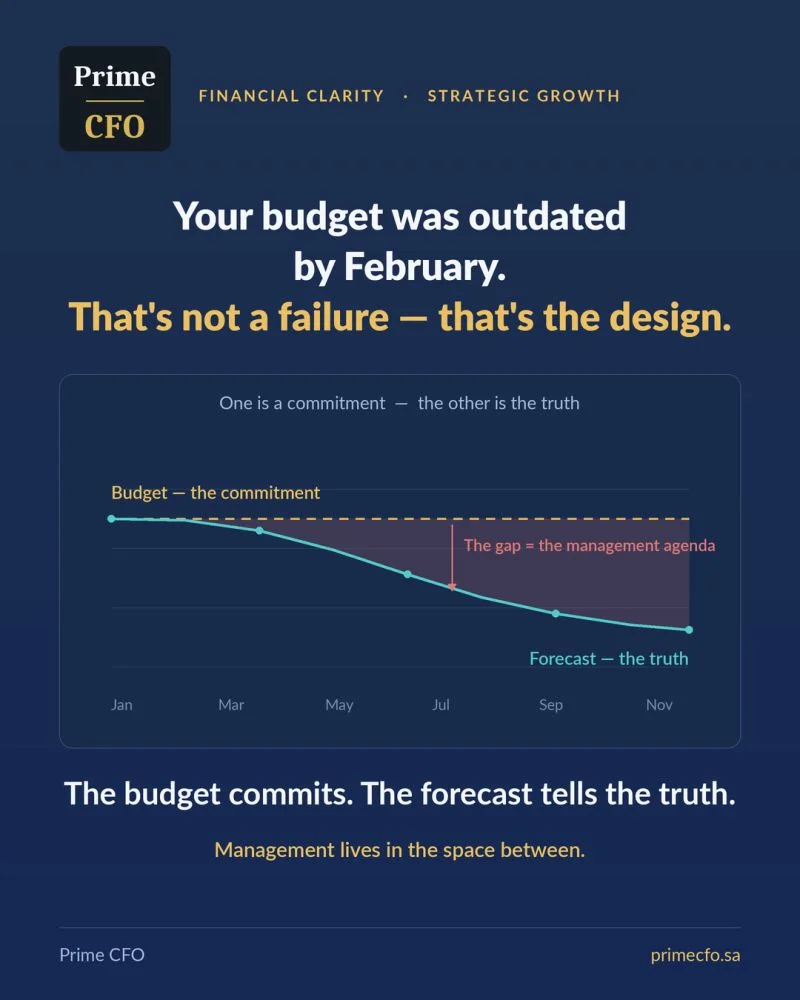
In almost every company the same scene repeats: the budget is approved in December, and by February everyone realizes it no longer describes reality. An unproductive debate about "updating the budget" follows. The problem is not that reality overtook the budget, that is expected. The problem is that we ask it to perform two contradictory jobs at once.
A mature finance function separates the two decisively: the annual budget is a commitment instrument, and the rolling forecast is a visibility instrument. From that separation comes the company's ability to act early.
The annual budget: a contract, not a prediction
A budget is, at its core, an institutional agreement defining three things: what management committed to before the board and owners, what each business unit owns of that commitment, and what resources were allocated to deliver it. It is deliberately fixed, because a target that moves every month stops being a target, and accountability moves with it.
A budget's fixity is not a flaw to be fixed; it is the source of its value. A company that revises its budget whenever reality shifts loses the reference against which performance is measured, and every variance becomes retroactively justified.
The rolling forecast: the visibility instrument
A rolling forecast works on the opposite logic: refreshed monthly, looking 12 to 18 months ahead rather than only to fiscal year-end, and absorbing every new fact as it arrives: a tender the company lost, a sudden spike in a key input cost, a hire delayed by three months, or a major client who stretched their payment cycle.
Its job is singular: to give the most accurate possible estimate of what will actually happen. It is not judged by how close it sits to budget, but by how honest it is. A forecast massaged toward the target loses its reason to exist.
The gap between them is the management agenda
Here lies the real value of separating the two instruments. When a March forecast shows the company closing the year eight percent below budget, management has nine full months to act: revisit pricing, tighten the cost structure, defer non-critical capital spending, or reallocate resources toward higher-return activities.
Discovering the same gap in October leaves no real room to act, and the performance meeting turns into explaining the past instead of managing the future. This pattern recurs in growth-stage companies: they do not struggle because they missed budget, they struggle because they found out late.
Forecasts are built on drivers, not line items
"Last year plus ten percent" is arithmetic, not planning. Forecasts worth having are built on the variables that actually drive the outcome: sales volume, price levels, utilization of capacity or assets, headcount and its cost, and collection and payment days.
The practical difference is large: a driver-based model answers management's real question, "what if?" What if a project slips by a quarter? What if material costs rise ten percent? What if collection days stretch from sixty to ninety? A line-item model simply reproduces the past with a new percentage, and answers nothing.
How this works in practice
Implementation is simpler than it appears, and rests on three elements:
- An annual budget approved once and held fixed as the accountability reference for the year.
- A rolling forecast refreshed monthly on a 12 to 18 month horizon, built on business drivers.
- One monthly meeting focused on a single question: what does the gap tell us, and what decision do we take on it this month?
A practical note from the field: do not start with a complex model. A forecast built on five or six real drivers and refreshed consistently every month is far more useful than a detailed model built once and abandoned after two months.
Three recurring mistakes
First: revising the budget mid-year to bring it closer to reality. The result is that the company loses its accountability reference and ends the year unable to say whether it delivered its commitment.
Second: massaging the forecast to look close to target. This empties the instrument of its purpose and delays discovery of the variance until action is no longer useful.
Third: measuring the gap without tying it to a decision. A gap presented monthly with no action becomes a report, and a report that changes no decision has no value.
The budget answers: what did we commit to? The rolling forecast answers: what do we now believe, given what we know? Companies are not surprised by results, they are surprised by the gap when they stop measuring it early.
Building this system, monitoring it monthly, and translating the gap into executive decisions is the core of what a Fractional CFO does with growth-stage companies. And if you want to know where your company stands today before building any model, the financial diagnostic is the starting point. For the shorter-horizon layer, read the 13-week cash flow forecast. And for its effect on executive decisions, read decision speed and capital allocation.
Does your company need a planning and monitoring system?
Start with an independent financial diagnostic that reveals where your company stands and which priorities deserve commitment this year.
Request a Financial Diagnostic