Profitable on Paper, Three Weeks from a Cash Problem: The 13-Week Cash Flow Forecast
Profit is an opinion; cash is a fact. A company can be profitable with a healthy P&L, then fail to meet obligations in one specific week. This piece explains how a 13-week cash flow forecast surfaces the gap early enough to act.
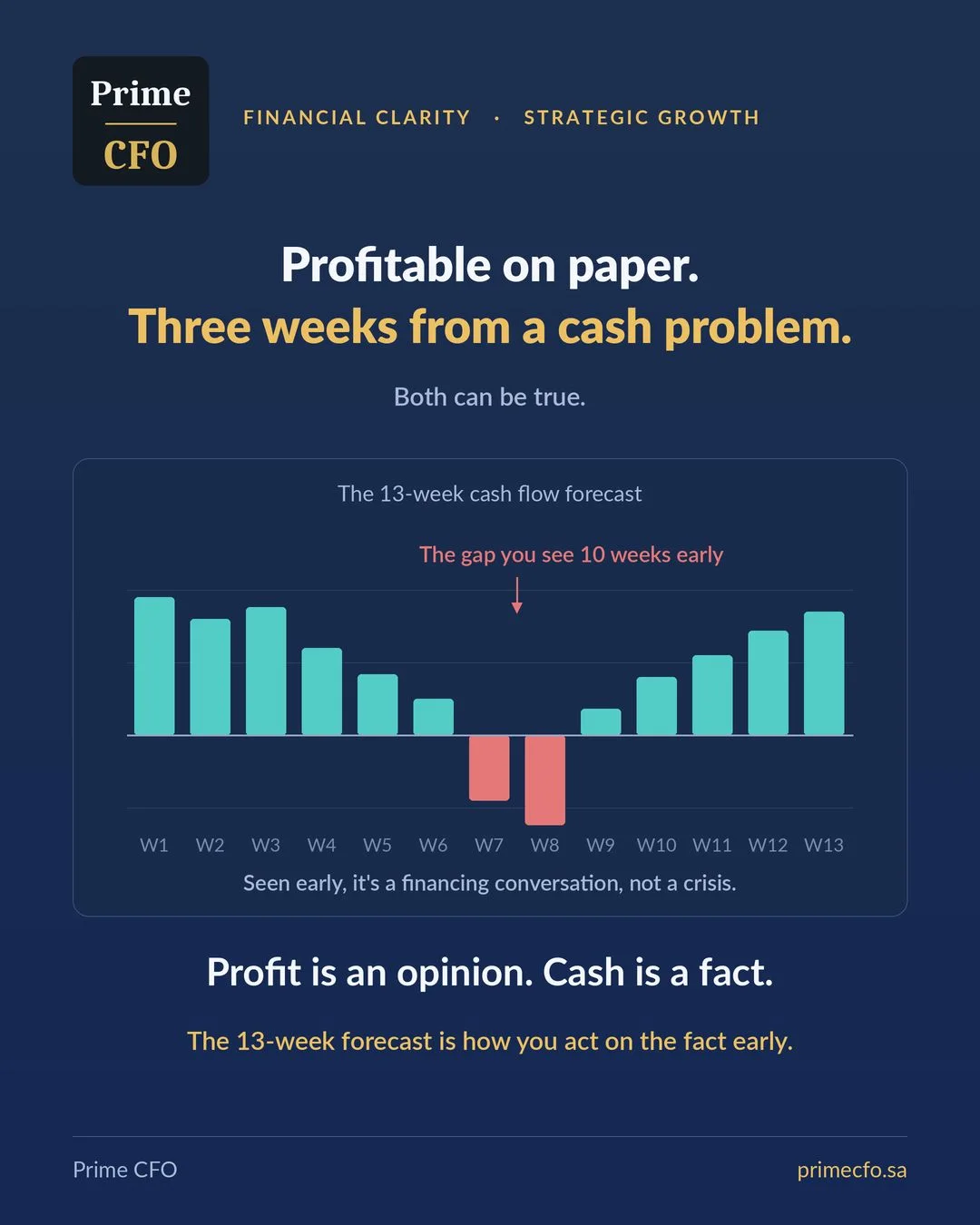
The scene is familiar in growth-stage companies: the P&L shows solid profit and management is at ease. Then payroll falls due, a major customer pays forty days late, and a key supplier demands payment in advance, all in the same week. Suddenly a profitable company cannot meet its obligations.
Profit did not cause the problem; timing did. That distinction is what makes an operationally sound company stumble while a less profitable one moves safely.
Why the P&L is not enough
The income statement is built on accrual: revenue is recognized when earned, not when collected, and expenses when incurred, not when paid. That is correct and necessary accounting, but it means the statement describes economic performance, not cash position. An invoice recognized as January revenue may not turn to cash before March, while January payroll is paid in January.
With growth this gap widens rather than narrows: more sales means more receivables and inventory, that is, more cash trapped in working capital. This is precisely why liquidity pressure intensifies in faster-growing companies, a paradox familiar to anyone who has worked close to the treasury of an expanding business.
Week by week, not month by month
A monthly view hides the crunch rather than revealing it. A month can look balanced in total while the company is unable to pay in its second week, then a large collection in week four offsets it and the month appears sound in the report. But the obligation in week two does not wait for the monthly average.
Liquidity problems occur on specific dates, not in averages. That is why the week is the correct unit of measure, and thirteen weeks (a full quarter) is the horizon that balances near-term accuracy with enough room to act.
Receipts based on behavior, not contract terms
This is where the most common error in cash models occurs. The contract states thirty days, but the customer actually pays in fifty-five. A model built on contract terms produces a systematically optimistic picture and collapses at first contact with reality.
A sound forecast is built on reality: how each major customer actually pays, using that customer's own historical collection days rather than a company-wide average. A government client on a ninety-day cycle and a private client on thirty cannot be treated with the same assumption, even if their contracts look alike.
Commitments, not just invoices
The outflow side must capture everything the company has actually committed to, not only invoices received: payroll and end-of-service accruals, rent, loan installments and interest, agreed supplier payments, approved capital commitments, and Zakat and tax on their due dates.
The key observation is that most of next quarter's cash outflow is already decided today. The forecast does not invent these numbers; it makes them visible on their correct dates before they become a surprise.
A rolling discipline, not a one-time exercise
The forecast is refreshed weekly through a simple mechanism: last week's actuals go in, and one new week is added at the end of the horizon so it always stays thirteen weeks. Within a month of this discipline, management knows its true forecasting accuracy: how far projections deviated from actuals, and exactly where.
That accuracy is an asset in itself in the banking relationship. A company that presents its bank with a disciplined cash forecast and a documented accuracy record negotiates from an entirely different position than one requesting a facility with estimated figures.
The result is not visibility, it is time
This is the instrument's core value. A cash gap seen ten weeks out is a calm financing conversation: arranging a facility, accelerating collections, rescheduling a payment, or deferring non-critical spending. The same gap seen ten days out becomes a crisis managed under pressure, with narrower options at higher cost.
How to start in practice
- Start from the actual opening balance on the bank statement rather than the ledger, then build the thirteen weeks on it.
- Separate the major customers who make up most of collections, forecast each on their actual behavior, then group the rest into one line.
- Lock in confirmed commitments on their dates: payroll, installments, rent, and Zakat and tax.
- Set a minimum operating balance you will not go below, and treat any week approaching it as an alert rather than just a number.
- Review it weekly in a short meeting devoted to one question: which week concerns us, and what action do we take today?
Profit is an opinion; cash is a fact. The 13-week cash flow forecast is how a company acts on that fact early, rather than after the fact.
Building this system, monitoring it weekly, and tying the cash gap to a timely financing or operating decision is an integral part of what a Fractional CFO does. You may also find our piece on budget versus rolling forecast useful for the longer-horizon layer of financial planning. For the effect of timing on decisions, read decision speed and capital allocation.
Do you know where your liquidity stands in the coming weeks?
The financial diagnostic reveals your liquidity and working capital position, identifying where cash is trapped and how it can be released.
Request a Financial Diagnostic