The Budget Is Not a Forecast, and Treating It Like One Is Why Yours Fails
Every September, a version of the same conversation happens. Finance sends the templates out. Department heads fill them in. The numbers come back 20% above what the business can fund. Finance cuts them by 20%. Everyone signs. By March, the budget is a document nobody opens.
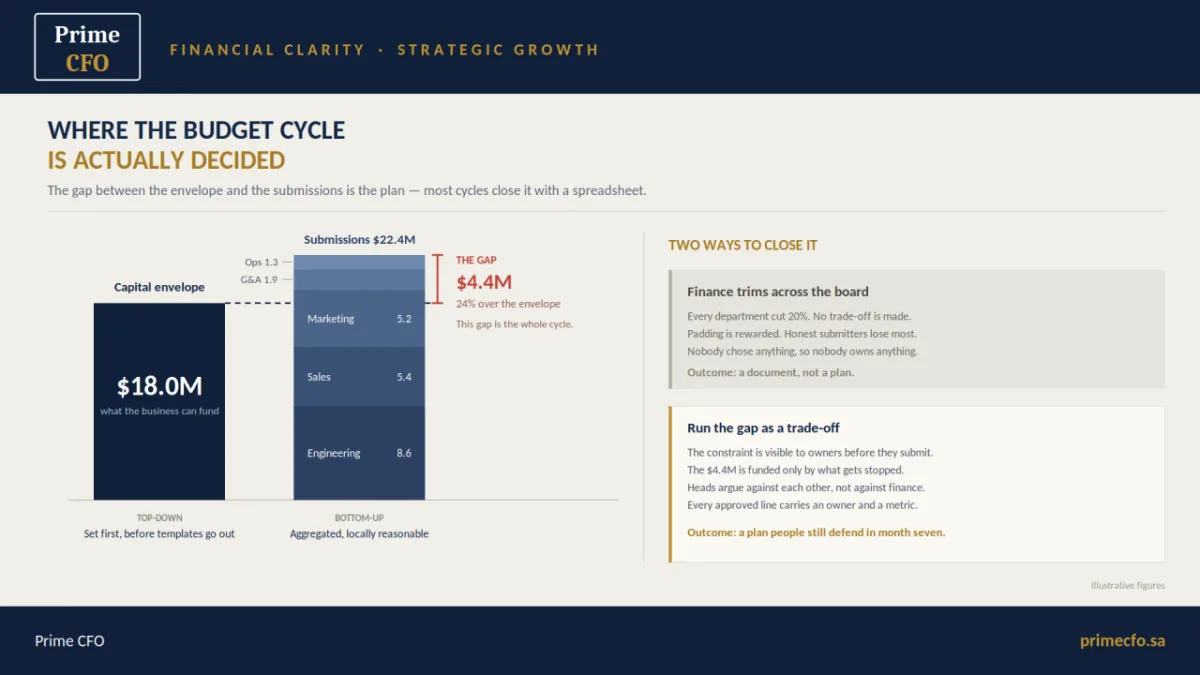
The failure is not in the process. It is in what the budget is understood to be.
A forecast is a prediction a best estimate of what will happen, and it should be updated the moment new information arrives. A budget is something else: an allocation of finite capital against a set of commitments, and a statement of what the business will hold people to. Confuse the two and you get the worst of both. A budget that is a bad prediction, and a prediction nobody feels accountable for.
The three failure modes, and what causes them
The submission is a negotiating position, not a plan. If department heads know finance will cut, they pad. If they know unspent budget disappears at year end, they spend it in Q4. Both behaviours are rational responses to the process finance designed. Neither is fixable by asking people to submit honest numbers.
Everything is built bottom-up. A bottom-up build tells you what people want. It cannot tell you what the business can afford, because no individual submitter holds the constraint. Aggregating twelve locally reasonable plans produces one globally unaffordable one, every time.
The output is a number, not a set of commitments. "Marketing gets $4.2M" is an allocation. It says nothing about what $4.2M is supposed to produce, which means there is no basis on which to evaluate it in month seven.
The structure that holds
Start with the envelope, not the templates. Before any submission goes out, the CFO should be able to state the total opex envelope and the logic behind it: what growth rate it supports, what margin or burn profile it implies, what it assumes about the funding position. That number is a constraint given to the business, not an output derived from it. It can move if the plan justifies it, but it starts fixed, and it starts first.
Then build bottom-up inside it, and force the reconciliation. The gap between the envelope and the aggregated submissions is not a problem to be solved by finance with a spreadsheet cut. It is the most valuable conversation of the entire cycle, and it should be run as a trade-off, not a trim: if sales gets the four extra AEs, what does not happen? Making department heads argue against each other, in the room, with the constraint visible, is the only mechanism that produces a plan people believe.
Apply the right level of rigour to the right cost. Zero-basing the entire cost structure is a six-week exercise that finance teams start with enthusiasm and abandon in October.
Attach an output to every allocation. Each material budget line should carry the metric it is expected to move and the owner accountable for it. Not KPIs bolted on afterwards, written into the budget at approval, so that the mid-year review has something to test against.
What the CFO is actually buying
The finished budget should answer four questions without anyone opening the model:
What are we betting on? The two or three investments that constitute the year's strategy, and what they are expected to return. What are we protecting? The floor: the margin, cash balance, or covenant that is not negotiable regardless of how the year develops. What flexes, and when? Which spend is conditional on performance, at what threshold, with the reforecast cadence that governs it. A budget with no conditional layer forces a choice between blowing through the plan and freezing in a downturn. Who owns what? Named accountability per line, not per department.
On accuracy
The instinct in FP&A is to treat budget variance as the scorecard; tight variance means a good budget. It is a weak measure. A budget can be highly accurate and useless, because it was set so conservatively that nobody had to make a hard choice. It can also miss materially and still have been the right plan, because the business took a bet, the bet is explainable, and the response was appropriate.
The better test is whether the budget changed a decision. Did something get funded that would not have been? Did something get killed? Did anyone have to argue? If the answer is no across the board, the exercise documented the status quo and called it planning.
And when it does miss, the reforecast is where the value comes back, provided the budget stays fixed as the accountability baseline while the forecast moves. Overwriting the budget with each reforecast feels tidy and destroys the only reference point you had.
Six weeks of the finance team's capacity goes into this cycle. It is worth being clear about what it is supposed to produce.
Turning these ideas into a disciplined monthly practice is core to the work of a fractional CFO. To see where your company stands today, start with the instant financial diagnosis, free during our founding period.
Read next
Do you know where your company stands financially today?
Upload your last two years of financial statements and get a financial health score and sector comparison in minutes, free during our founding period. If you need executive financial leadership, we are here.
Try the free financial diagnosis