Variance Analysis: "8% Below Budget" Is Not Analysis
Most variance reports stop exactly where the useful work begins. They tell management the size of the gap, then move to the next line. Nobody is wiser, and nothing changes.
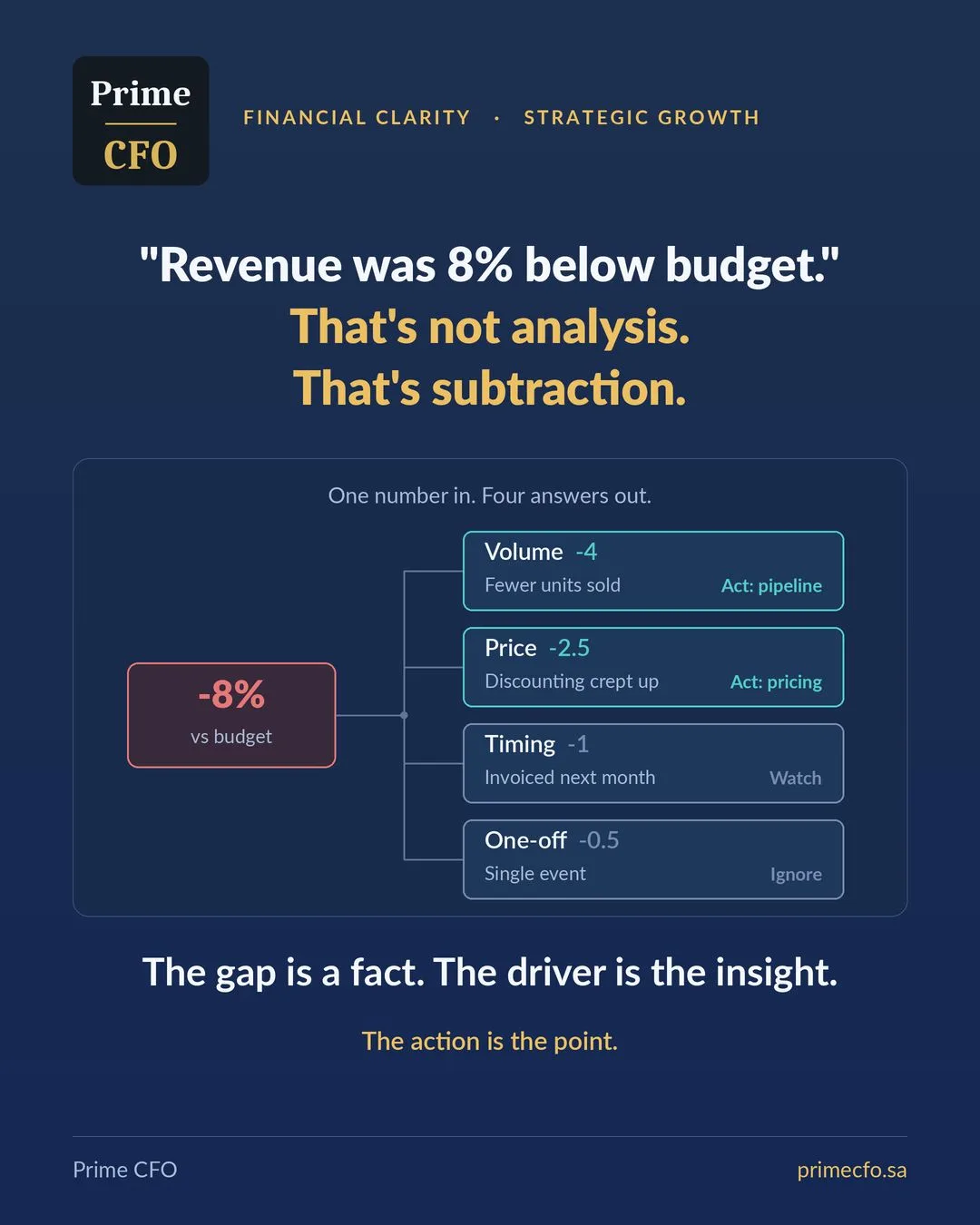
A variance only becomes useful when it's decomposed into drivers:
1. Volume or price?
Revenue missed by 8%. Did we sell fewer units, or the same units for less? The first is a demand or pipeline problem. The second is a pricing or discounting problem. Completely different actions.
2. Rate or efficiency?
Payroll over budget: did we pay more per person, or use more hours than planned? Materials over budget: price increase, or waste? Each split points to a different owner.
3. Timing or permanent?
A project invoiced in July instead of June reverses next month. A lost customer doesn't. Mixing the two in one number is how real problems hide behind temporary noise.
4 . One-off or structural? A single bad month is information. Three months of the same drift is a trend. The report should say which one management is looking at.
Then the only part that matters: so what? Every material variance ends with an owner, an action, and a date. If the commentary doesn't change what someone does next week, it's documentation, not analysis.
The gap is a fact. The driver is the insight. The action is the point. Variance analysis isn't about explaining the past. It's about correcting the future.
Turning these ideas into a disciplined monthly practice is core to the work of a fractional CFO. To see where your company stands today, start with the instant financial diagnosis, free during our founding period.
Read next
Do you know where your company stands financially today?
Upload your last two years of financial statements and get a financial health score and sector comparison in minutes, free during our founding period. If you need executive financial leadership, we are here.
Try the free financial diagnosis